what she means: that episode was so brilliantly and beautifully written by the outstanding malorie blackman. it handled racial issues whilst educating young children and adults about rosa parks and why her story is so important, young people may have a new hero in thirteen but they also have a new hero in rosa parks and i think that is incredible. the doctor who creaters, cast and malorie blackman really did what all primary schools in britain and perhaps worldwide fail to do: teaching children the importance and story of black history. the episode was without a doubt the most moving and poignant thing ever shown on bbc and possibly on television as it was powerful, hard hitting, emotional and everything was done right from the representation of rosa to the music choice (rise up was the perfect piece to use) to the ending where we saw the real rosa. the best episode of doctor who to date !!!!!
Am I rewatching the new Doctor Who ep for the third time today? PERHAPS.
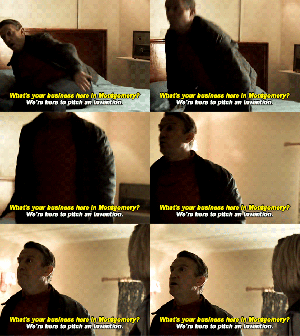
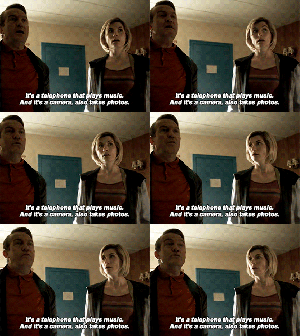
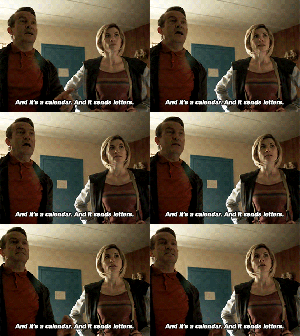
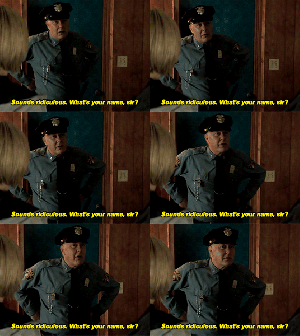
But one of the things that stands out to me so much about this episode is that it washes away a lot of the things that made me frustrated about the Moffat era.
The plot MAKES SENSE. I feel like I could use this ep to introduce anyone to Doctor Who and it would make sense. It’s not concerned with being THE MOST “CLEVER” THING ON TV. It’s not concerned with twists and turns and surprises that aren’t earned just to prove how clever the writers are.
It’s fun. It’s legitimately fun.
The new companions? There doesn’t seem to be a big mystery about them (*cough*Clara*cough*River*cough*) They seem like normal people who were just in the right/wrong place at the right/wrong time. GIVE ME MORE OF ANYONE CAN BE HEROIC INSTEAD OF ONLY THE *SPECIAL* TRAVEL WITH THE DOCTOR. Let me see myself in them cause I’m not special, but I bet I could be if I got to travel with her.
Showing that the Doctor is brilliant and clever and quick instead of just telling and telling and telling me.
All the companions get to use their knowledge to help the Doctor. And it’s not magic knowledge, it’s things like bus drivers and police work and social media.
The Doctor never pulls a ‘no I have to go alone’ bullshit – everyone’s like ‘how do we help?’ and she’s all ‘C’MON FAM WE’RE GOING TO FIX THIS TOGETHER’.
What I love about this is its acknowledgment that Jason had no intentions at all
this is all 100% true but it always made me really mad that Chidi’s “crime” was having a severe anxiety disorder like he needed understanding and therapy, sending him to the Bad Place for something he had literally no control over was incredibly fucked up
I feel like a less-surface theme of the show is that they’re all in a situation where they have been forced into bad patterns by forces outside their control – Chidi has SEVERE anxiety; Eleanor was forced by abuse and neglect to adopt a self-centered attitude from early childhood and, like many people with traumatic pasts, responds by not dealing with difficult emotions; Jason was very overtly raised in an environment where he got no education and all his models for behaviour were criminal and/or self-destructive; and Tahani has been raised in an environment where everything is performative and she is shot down for any genuine expression of unhappiness or non-material want. Just as Michael and Janet are made one way but changed by their experiences, the moral of the story is that things outside your control shape you but you can move away from them. That could easily be really insulting, in a sort of ‘just get over it’ way, but the idea isn’t that they change solely because they decide to be better – all six of them change because their circumstances change and give them the OPPORTUNITY to be better, because they’re finally given the support system they lack.
I like The Good Place because the whole show has since day 1 been predicated on the idea that black and white moral judgements made in a vacuum are bullshit, and that moral choices are informed by things outside our control, whether that be education, behaviour modelling, unfair treatment or mental health issues. That doesn’t mean we aren’t responsible for our actions but it DOES mean we have to understand morality in the context of people’s varied experiences AND asks for the possibility that if their environment is improved, their ability to function as moral agents also improves.
The whole premise of their redemption of Michael and his actions in late season 2/3 is that the system is wrong – not only does the group not deserve to be in the bad place as individuals – but that the system itself is wrong. If these are all people who could be ‘good’ – then judging them based on a life cut short before they could learn to do better given their awful starter issues (anxiety, emotional neglect, physical and emotional neglect, and stupidity (sorry, I love Jason but he’s spectacularly dumb)) means that the system itself is wrong – which is Michael’s argument to the judge and why we have season 3.












 Amber
Amber 